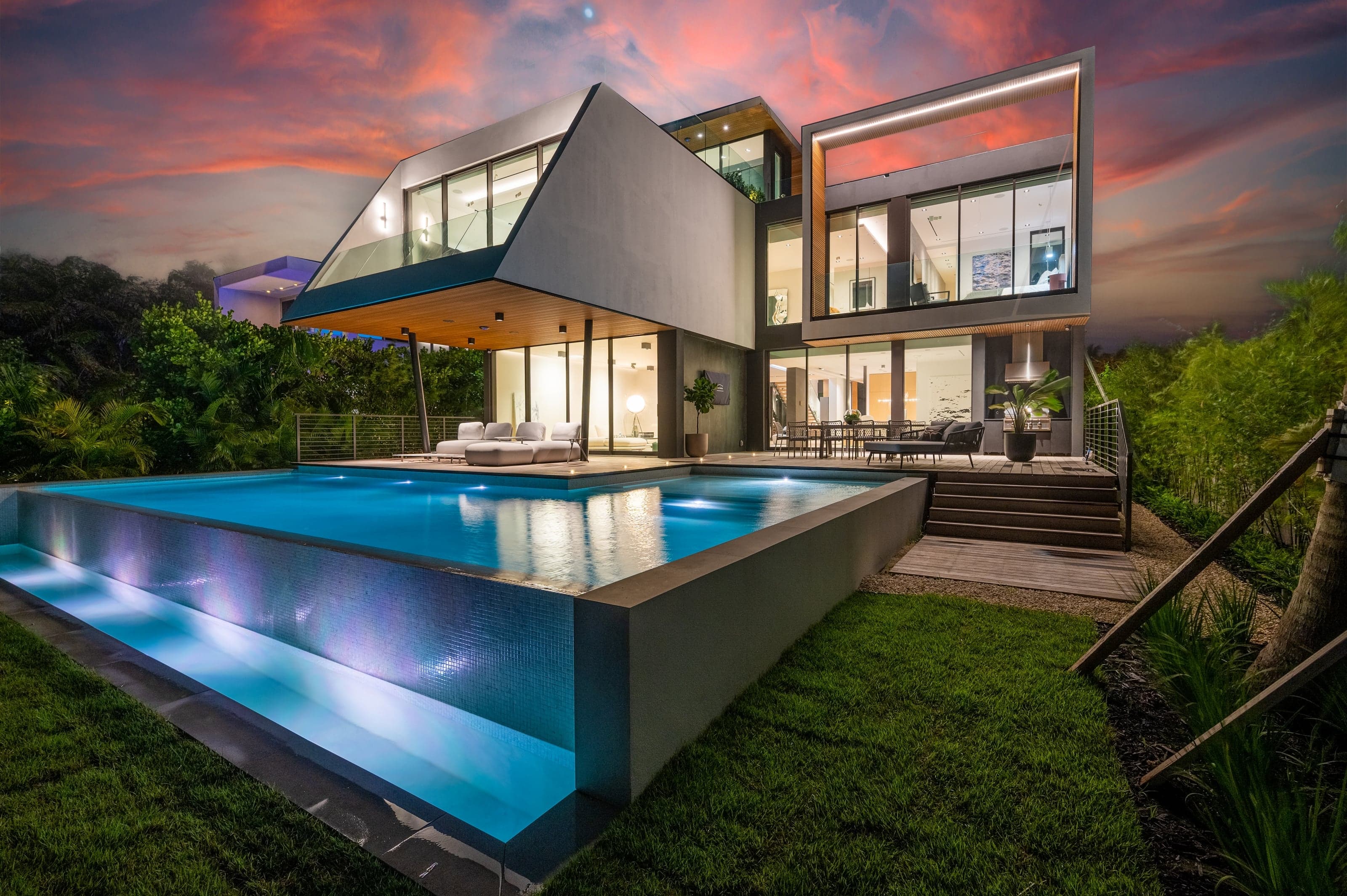
Luxury Home Construction Cost Per Square Foot in Miami (2026)
Honest 2026 ranges for custom luxury construction across Miami-Dade, Broward, and Palm Beach — $450 to $1,800+ per square foot, and the spec decisions that actually move the number.
The question every principal commissioning a new residence in South Florida eventually asks: "what should this cost per square foot?" The honest answer most builders avoid is that the number is almost meaningless without specifying the band, the submarket, and what is included in the denominator. This guide gives you the actual 2026 ranges Sabal sees on signed contracts across Miami-Dade, Broward, and Palm Beach County — and the spec decisions that move you from one band to the next.
The four bands we see on signed contracts (2026)
A "luxury home" in South Florida spans almost a 4x cost range. The four bands below are where actual contracts land, conditioned air-conditioned square footage, hard construction cost only (excludes land, design fees, soft costs, FF&E, and landscape unless noted).
$450–$650 / sq ft — high-end production custom
Single-family residences in established mainland Miami-Dade or Broward neighborhoods (Coral Gables off-water, parts of Pinecrest, Coconut Grove interior, eastern Fort Lauderdale). Cleanly designed 6,000–8,000 sq ft programs with stone and porcelain flooring, solid-wood interior doors, mid-tier European cabinetry (Poliform, Boffi at the upper end), Sub-Zero/Wolf kitchens, factory-spec impact glazing. Builder-grade structural systems (post-tensioned slab on grade or basic CMU shell). This is what "luxury" means at the volume end of the South Florida market.
$650–$900 / sq ft — bespoke custom on mainland
Same neighborhoods, larger programs (8,000–14,000 sq ft), thicker spec. Custom architectural millwork throughout, real stone walls (not veneer), Wolf full-suite kitchens with custom hood housings, dedicated wine room, primary suite as its own architectural moment, infinity-edge or perimeter-overflow pool, automated shading and lighting through a Lutron Homeworks or Crestron platform. Structural steel in selected spans where post-tensioned concrete is awkward. Most of our Coral Gables, Bay Drive, and inland Fort Lauderdale work falls here.
$900–$1,300 / sq ft — waterfront and private-island custom
Direct-waterfront parcels — Venetian Islands, Hibiscus Island, Star Island, North Bay Road, Sunset Lake, Manalapan, Highland Beach, Gulf Stream. The cost lift over mainland custom is real and largely structural: deeper foundations on filled marine soils, marine-grade everything from seawall to dock to outdoor kitchen hardware, hardened envelopes for direct-fetch wind exposure, and the logistical premium of barging materials onto islands with restricted truck access. Interior spec moves up another tier — bookmatched stone slabs, full custom cabinetry, plaster-finish walls, glass-encased wine cellars, full-house generators sized to maintain the entire program through extended outages.
$1,300–$1,800+ / sq ft — oceanfront and overlay-constrained
Atlantic oceanfront parcels in Palm Beach County (Town of Palm Beach, Manalapan, Highland Beach, Gulf Stream, Singer Island) and the most-restricted Miami-Dade locations (Sunset Islands #1 and #2, the Cocoplum waterfront). What pushes the number is the layered overlap of CCCL foundation engineering, ARCOM or local architectural-review constraints on massing (which often force more elaborate roof systems and detailing), 175-mph-comparable wind loads on every opening, premium-tier finishes throughout, and the realities of building inside a tight community where staging, neighbor coordination, and limited-access logistics each carry their own multiplier. Sabal's Highland Beach (4005 S Ocean) and Manalapan (3050 S Ocean) projects land in this band.
What drives the per-sq-ft number — the 10 actual levers
Per-sq-ft pricing varies primarily because of these ten specifications. In rough order of impact:
- Site conditions — sand vs coquina vs fill; depth to bearing strata; demolition or remediation required. A 30-foot pile foundation under a 10,000 sq ft house is a 6-figure delta vs spread footings on competent native soil.
- Structural system — wood-frame (rare here), CMU shell, post-tensioned concrete, hybrid steel-and-concrete. The decision is partly architectural (long open spans, cantilevered overhangs need steel or PT concrete) and partly hurricane-driven.
- Envelope — exterior cladding (stone, stucco, Resysta wood, metal panel), window-wall systems (architectural-grade aluminum vs steel windows like Crittall or Bonelli), roof system (standing-seam metal, clay tile, low-slope membrane). A steel-window package can add $150–$300/sq ft on its own.
- MEP density — number of zoned HVAC systems, heated tile flooring, full-home water filtration, ozone pool sanitation, audio-video infrastructure, security system depth. A house with 14 HVAC zones, 8 bathrooms, and full Crestron AV is fundamentally a different cost than the same square footage with 4 zones and basic AV.
- Kitchen + bath quantity and tier — every full bath above 6 adds notable cost; primary baths with steam, dual showers, custom slab work, and bookmatched stone push toward the upper bands; chef-grade kitchens with multiple islands, secondary scullery kitchens, and full appliance suites are entirely different from a single-island family kitchen.
- Millwork — site-built custom millwork vs imported European cabinetry (Molteni, Poliform, Boffi, Bulthaup) vs hybrid. Full-house custom millwork in a 12,000 sq ft program is often $400k–$1.2M on its own.
- Smart-home infrastructure — Lutron Homeworks vs Crestron vs Savant, depth of integration (shading, lighting, AV, climate, security, motorized everything). A meaningful Crestron program in a 10,000 sq ft house is $300k–$600k installed.
- Pool, spa, outdoor living — basic perimeter-overflow vs glass-walled infinity, outdoor kitchens, summer rooms with retractable screens, putting greens, sport courts. Aquatic features alone span $150k to $1.5M.
- Landscape and hardscape — frequently excluded from per-sq-ft quotes but a real component of total project cost. Mature specimen palms, fountain systems, motor-court paving, and irrigation can add 5–12% to total project cost.
- GC fee structure — cost-plus-fee with a fixed fee, percentage of cost, or GMP each produce different effective per-sq-ft outcomes. Builders quoting all-inclusive turnkey numbers usually carry their fee inside the per-sq-ft figure; cost-plus builders quote the construction cost only.
Submarket variants
Miami-Dade
Largest subcontractor pool in Florida, established marine and concrete trades, HVHZ (High Velocity Hurricane Zone) wind requirements that drive envelope and connection costs about 8–12% above non-HVHZ markets. Permitting friction varies by municipality — City of Miami and Miami Beach are well-staffed and predictable; some unincorporated areas and the smaller barrier-island municipalities run slower. Costs are generally tightest on mainland parcels and rise meaningfully on Venetian, Hibiscus, Star, Palm, and the bayfront stretches of North Bay Road and Sunset Drive.
Broward County
Lower base cost than Miami-Dade, similar HVHZ requirements. Fort Lauderdale Las Olas Isles and Hillsboro Beach are the primary luxury submarkets. Subcontractor pool is shallower than Miami-Dade for the upper-tier custom trades (specialty stone, custom millwork, marine), so we typically pull from Miami-Dade for those scopes when delivering in Broward. Net effect: a marginal premium over base Fort Lauderdale rates for top-tier work, still below comparable Miami-Dade waterfront pricing.
Palm Beach County
Palm Beach County is technically outside HVHZ, but every serious oceanfront residence in the county is spec'd to HVHZ-comparable wind standards. Costs run 10–25% above comparable Miami-Dade waterfront, driven by: (1) FDEP CCCL permits on oceanfront parcels, (2) the layered local design review (ARCOM, Gulf Stream ARPB, Manalapan Architectural Commission, etc.), (3) a smaller, more specialized local trade pool, and (4) the logistical premiums of A1A access on barrier-island parcels.
Why "per square foot" is honestly an imperfect metric
Per-sq-ft pricing flattens the variability that actually determines a custom home's cost. A 12,000 sq ft house with 14-foot ceilings, four full kitchens, ten bathrooms, three primary suites, and a wine cellar costs roughly the same as a 16,000 sq ft house with 10-foot ceilings, one kitchen, six bathrooms, and standard storage. The first is $1,200/sq ft; the second is $900/sq ft. Same total cost. Same level of luxury for the program.
What we recommend to clients comparing builders: ask for cost per habitable room (kitchen, bath, primary suite, etc.), and ask for the full breakdown of what is and isn't included in any per-sq-ft number quoted. The honest builders will give it. The builders who only quote per-sq-ft and refuse to break it down are usually carrying assumptions you don't share.
What we typically see on a signed luxury contract in Miami-Dade and Palm Beach (2026)
For a meaningful baseline: across active Sabal mandates in 2026, the median signed contract is approximately 9,400 sq ft conditioned area, $7.4M hard construction cost, which works out to ~$790/sq ft on the mainland and ~$1,050/sq ft on direct-waterfront. The top of our active book is a sub-3-year project in Manalapan running closer to $1,400/sq ft because of the oceanfront CCCL foundation, the spec depth, and a fully custom architectural envelope. The bottom is a 7,200 sq ft Coral Gables off-water residence at $620/sq ft with a high-end-production spec and a straightforward CMU shell.
Every one of those numbers is fully documented in the cost-plus accounting we share monthly with each principal. The transparency of that accounting is itself part of the difference between this band of builder and the volume custom market — when you can see every invoice flow, the per-sq-ft number stops being a marketing line and becomes a working tool for the decisions still in front of you.
The band you land in also depends on who you hire. Our guide to choosing among luxury home builders in Miami covers what to ask before you sign, and the companion piece on what it costs to build a custom home in Miami in 2026 walks the same numbers neighborhood by neighborhood.
Where this leaves you as a principal
If a builder quotes you $450/sq ft for an oceanfront Palm Beach build, walk. If a builder refuses to commit to any range until 12 months of preconstruction, that's a yellow flag too — by signed architect contract, an experienced builder can give you a band of ±15% and a path to tighten it. The right answer is somewhere between those extremes: a band that respects your program ambition, your submarket, and the realities of what the trades and materials cost in 2026, plus a transparent path to refining the number through design development.
If you want a conversation about what your specific program would actually run, the contact form on this site goes directly to Pascal — and we'll give you a real range, not a brochure number.
Por Pascal Nicolai