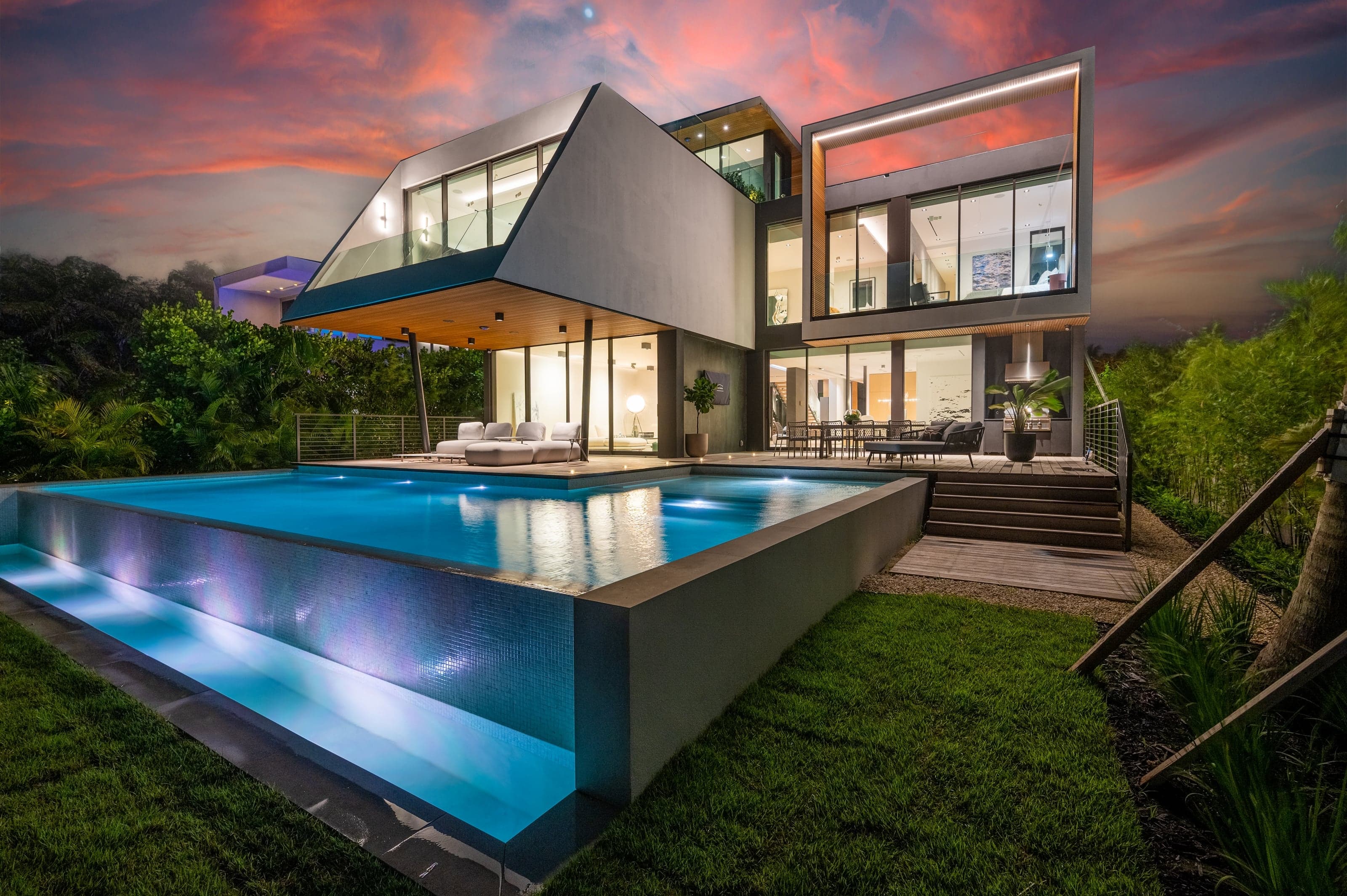
Custom Home vs. Spec Home in South Florida: Which Is Right for You?
The buy-versus-build decision in Miami and Palm Beach is rarely about price — it is about time, control, and risk. A practical framework from a builder who has delivered both.
Every quarter we get the same call: a buyer has been looking at finished spec homes in Indian Creek, Star Island, or the Royal Palm Yacht Club, and one of them is close enough to right. The seller wants $25M. A custom build on a similar lot would run $18M plus 24 months. The math looks simple. It is not.
This is the buy-versus-build conversation in South Florida luxury, and it has fewer right answers than it has variables. Here is the framework we walk every owner through before they decide.
The fundamental difference
A spec home is built by a developer or builder on speculation — they choose the design, finishes, layout, and lot, complete the project, and list it. The buyer inherits the result. A custom home is built by the buyer, for the buyer, on a lot the buyer owns. Every decision — from foundation layout to door hardware — is made or approved by the owner.
Both can be excellent. We have built both. The question is not which is better in the abstract — it is which fits the owner's constraints.
Time to move in
A finished spec home closes in 30–60 days. A custom home in South Florida runs 28–36 months from lot acquisition to certificate of occupancy. If the owner needs a Miami Beach residence by next winter, a spec home is not a "preferable" choice — it is the only choice.
The exception: a spec home mid-construction can sometimes be redirected to the buyer's preferences if the framing is not yet complete and the developer is open to a contract assignment. We have seen this work twice in five years. Plan for it not to.
Total cost — apples to apples
The simplest way to compare is land plus build versus listed price.
Spec premium typically runs 18–28% above what an owner-managed custom build would cost on the same lot, same program. The premium pays for the developer's carrying cost, profit, and the value of finished delivery.
A $20M spec on a $5M lot represents about $11M of construction value — a number that an owner with the same lot and program could deliver for $8.5M to $9.5M custom. The spread is real, and on a $20M+ purchase, it matters.
Counterpoint: the construction loan, design risk, and 30-month opportunity cost of the owner-built path is real cost too. Smart buyers compare total cost of ownership, not just sticker price.
Personalization
A custom home is built around a specific family. The kitchen serves the way you cook. The primary suite faces the morning light you wake to. The garage holds the cars you drive. The wine room sizes to the cellar you have. None of this is true of a spec home, however excellent.
For a primary residence the owner expects to live in 10+ years, this gap matters. For a fourth home, a Miami pied-à-terre, or a vacation property used six weekends a year, it matters less.
Resale flexibility
The conventional wisdom — that custom homes are harder to sell because they reflect the owner — is overstated for South Florida luxury. The buyer pool here values quality, location, and waterfront more than layout idiosyncrasies. We have sold clients' custom homes for substantial gains over construction cost in three of the last four cycles.
That said: highly personalized features (a basketball court, an indoor pool, a recording studio) do narrow the resale market. If resale is a meaningful part of the calculus, design with mainstream tastes in mind even on a custom project.
Land ownership and lot value
Spec home buyers acquire the package. Custom owners typically acquire the lot first, then build. Lot scarcity in tier-one South Florida neighborhoods — Star Island, Indian Creek, Manalapan — means the lot is often the appreciating asset, not the structure on top of it.
If the owner already owns a teardown candidate or a vacant lot in a tier-one zip code, the custom path is almost always superior. If they are starting from cash with no specific lot in mind, spec opens the inventory and shortens the search.
Risk profile
Custom-build risk is real and worth naming:
- Schedule risk — permits, weather, supply chain. We carry contingency, but no contingency covers a 6-month permit delay.
- Cost risk — material price volatility, owner-driven scope changes, and discovery once site work begins.
- Design risk — architect coordination, engineer revisions, and the gap between rendering and reality.
- Construction-period risk — financing carry, alternative housing, displacement of plans tied to the move-in date.
A spec home transfers all four of these risks to the developer. The buyer pays for that transfer in the spec premium — and gets it. For owners who do not have the bandwidth or risk tolerance for a 30-month construction cycle, this is the single strongest argument for buying spec.
The hybrid: semi-custom
A growing share of our work falls between the two: an owner identifies a spec project mid-construction, contracts an assignment, and we redirect the back-half decisions — finishes, kitchen, primary suite, landscape — to the new owner's program. The shell, structure, and building envelope stay as designed. Roughly 60–70% of the personalization of a true custom for 75–85% of the spec timeline.
It is not always available, and the developer has to be willing. When it works, it is often the right answer.
A three-question decision framework
When an owner asks us "should we build or buy," we answer with three questions:
1. When does the family need to be in the house?
Within 12 months → spec or semi-custom. Beyond 24 months → custom is on the table.
2. How long will you live in this home?
<5 years → spec is usually right; the personalization premium does not amortize. >10 years → custom almost always wins on satisfaction and total cost of ownership.
3. Do you already own the lot, or are you buying one?
Already own → custom unless the lot is wrong. Need to acquire → reassess: tier-one inventory of lots is so thin that a finished spec on a great lot may beat an open lot search of 18 months plus a 30-month build.
What we tell most owners
For primary residences in tier-one South Florida zip codes, with an owner who has the time and the lot — custom wins. The home fits, the cost is rational, and the asset is exceptional.
For second homes, time-pressured moves, or owners without a specific lot — a well-built spec home from a reputable developer is almost always the right call. Save the build energy for a residence the family will actually live in.
There is no universal right answer. There is a right answer for each owner, and it usually becomes clear within an hour of looking at the program, the timeline, and the lot together.
By Pascal Nicolai