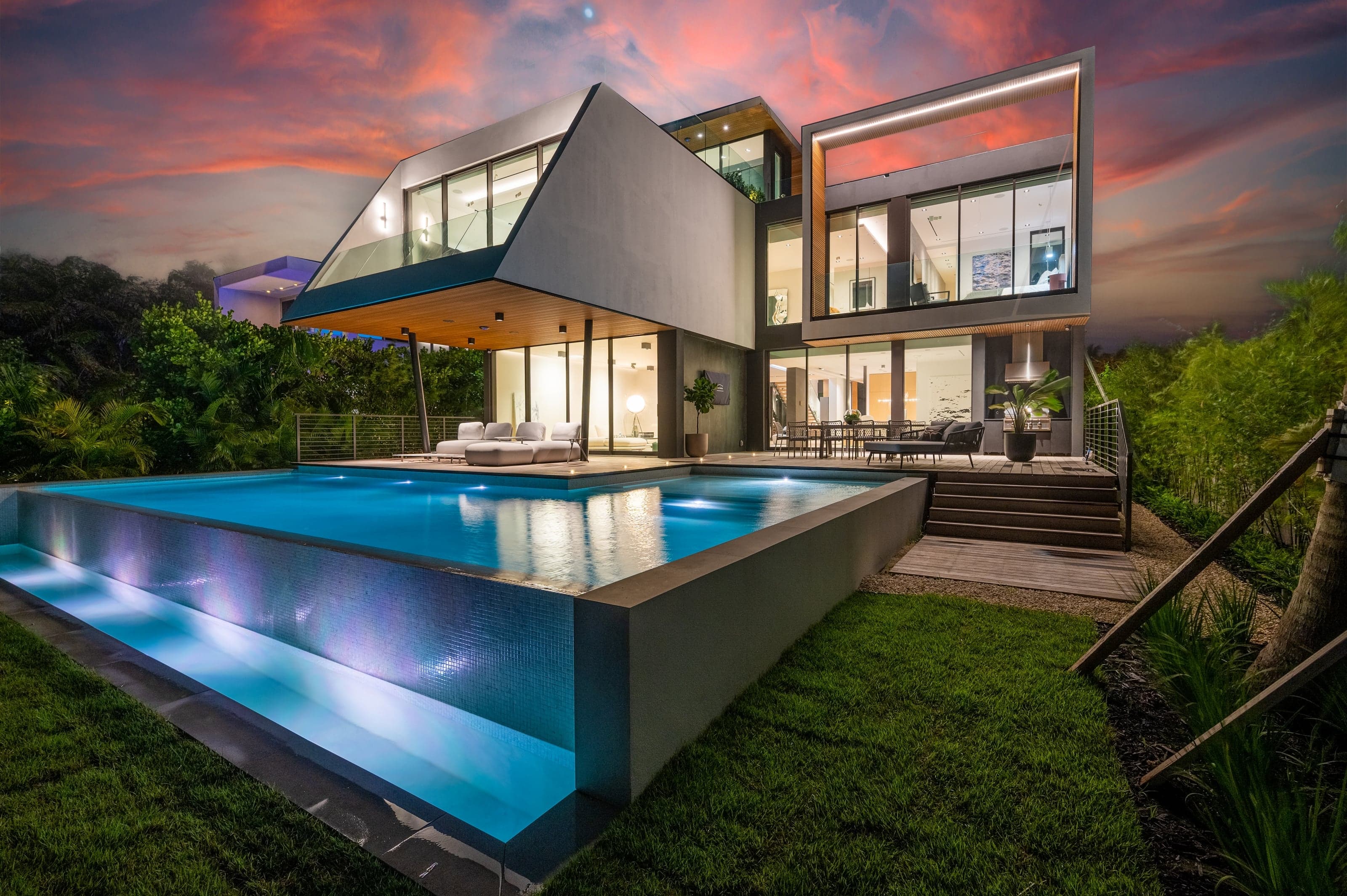
How Much Does It Cost to Build a Custom Home in Miami in 2026?
A transparent breakdown of what a high-end custom home costs to build in Miami today — by neighborhood, finish level, and the variables most owners never see coming.
The honest answer most builders avoid giving: a true custom home in Miami in 2026 ranges from $750 to $2,500 per square foot, all-in. A 6,000 sq ft waterfront residence in Indian Creek will sit closer to $15M; the same square footage on a standard lot in Coconut Grove can come in at $5.5M. Both are luxury. Both are "custom." The price gap reflects four variables — and most owners only learn about three of them too late.
This guide breaks down what those numbers actually contain, why per-sq-ft benchmarks vary so much by neighborhood, and how to avoid the budget surprises that derail roughly one in three South Florida builds.
The four variables that move the price
Before you can compare quotes from builders, you need to know what those quotes are actually pricing. The four levers, ranked by impact:
- Site conditions — soil, elevation, existing structures to demolish, seawall replacement, and proximity to a flood zone. A waterfront teardown in Miami Beach can absorb $300K–$600K before a single new wall goes up.
- Finish and millwork level — the gap between "high-end developer-grade" and "true custom millwork from European cabinetmakers" is often $200–$400 per sq ft alone.
- Architect and engineering complexity — a Choeff Levy Fischer or a Max Strang design adds creative value but usually requires structural and MEP coordination beyond a standard custom build.
- Hurricane and resilience code — Miami-Dade has the most stringent code in the United States. Impact glass, structural steel, elevated mechanical, and generator integration add 8–12% to the base shell cost.
Per-square-foot benchmarks by neighborhood
These are based on projects Sabal has delivered or competitively bid in the last 18 months. They cover the construction line on the contract — they do not include land, design fees, FF&E, landscape, pool, dock, or interior design.
Brickell / Edgewater (urban infill)
High-rise-adjacent lots, party walls, downtown logistics, vertical staging — $850–$1,400 per sq ft. Crane access alone can add $200K to the soft costs. Permitting through City of Miami is more predictable than the islands but slower than the Beaches.
Coconut Grove
Tree canopy preservation, narrow lots, owner-emphasis on indoor-outdoor living. $750–$1,200 per sq ft for a custom build on an existing footprint. Demolition and tree mitigation can run $100K–$250K independently.
Coral Gables
Mediterranean Revival code overlay, City of Coral Gables review board, and HOA-style architectural restrictions on most blocks. $800–$1,300 per sq ft. Add 6–10 weeks to permit timeline vs. county-jurisdiction projects.
Miami Beach (Sunset, Hibiscus, Palm, Star, La Gorce)
Waterfront premium, soft soil, high water table, seawall and dock work. $1,000–$1,800 per sq ft for non-private-island. Star and Indian Creek custom builds regularly clear $2,000+ per sq ft once interior design and dock work are folded in.
Palm Beach / Manalapan / Hillsboro Mile
Long-distance logistics from a Miami-based GC, code differences, and a tighter local sub-trade pool. $900–$1,800 per sq ft. Owner-direct architect-builder coordination becomes essential — divided responsibility almost always inflates the final number.
Hard costs vs. soft costs — what most quotes hide
When a builder says "$700 per sq ft," ask what is in that number. Hard costs (materials and labor on the construction line) are typically 70–80% of the all-in figure. The remaining 20–30% — soft costs — are where surprises live:
- Architecture and engineering (5–9% of construction cost)
- Permits, impact fees, and Miami-Dade tap fees ($75K–$200K depending on size and zone)
- Geotechnical, environmental, and survey ($25K–$60K)
- Construction-period insurance, builder's risk, and bond ($30K–$90K)
- Owner-furnished items: appliances, fixtures, plumbing fixtures (often $400K–$1.2M on a luxury build, contracted separately)
- Landscape and hardscape ($150K–$500K typical, more for waterfront)
- Pool, spa, and dock (combined $300K–$900K)
- Furniture, fixtures, and equipment — interior designer scope ($500K–$2M+)
A builder who quotes only the hard cost without setting expectations for the soft costs is either inexperienced or selling a teaser number. Either way, you will hear about the missing line items 18 months in.
The hurricane code premium — and why it matters
Florida Building Code, Miami-Dade High Velocity Hurricane Zone (HVHZ) edition, is the most demanding residential code in the country. Every glass opening must be impact-rated and pressure-tested. Roof attachment, fenestration, and exterior wall assemblies require notarized engineering. The structural systems use more steel and tighter connections than a Texas or California build of the same size.
For a 6,000 sq ft home, the HVHZ premium runs $400K–$800K above a comparable inland build. It is not optional, and it should never be value-engineered away — the homes that survive the storms are the ones built to spec, not above the line item.
Permits, fees, and the timeline
In Miami-Dade unincorporated and most municipalities, plan a 4–7 month permit cycle for a new single-family build. Coral Gables and Miami Beach can stretch to 9–12 months for designs that require board review. Construction itself for a 6,000 sq ft custom home runs 14–22 months from groundbreaking to certificate of occupancy.
Owners frequently underestimate the pre-construction phase. From signed architect contract to a permitted set of drawings, expect 9–14 months on a complex custom build. The total time-to-keys, lot to certificate of occupancy, is often 28–36 months. A builder who promises 18 months on a $10M+ home is either building from a stock plan or making a number up.
How Sabal prices a project
We use cost-plus with a guaranteed maximum on most projects above $4M. The owner sees every subcontractor bid, every change order, every invoice. Our fee is fixed at contract; if we save money against the GMP, the owner keeps it. If we run over, that is on us.
Lump-sum and design-build models exist and have their place. For sophisticated owners with their own architect and an interest in transparency, cost-plus with a GMP gets the right home built without surprises — and our retention rate of repeat clients reflects that.
For the per-square-foot bands behind these figures — $450 to $1,800+ by spec level and submarket — see our luxury home construction cost per square foot in Miami guide. And before you compare quotes, read how to evaluate luxury home builders in Miami — the builder you choose moves the number more than any finish decision.
What to do next
If you are within 12 months of breaking ground, the highest-value first step is a preconstruction estimate based on schematic drawings — not a shell number from a contractor who has not seen your site. We do these on a fixed-fee basis, refundable against the construction contract. The output is a line-item estimate, schedule, and risk register that lets you make budget decisions with real numbers in hand.
If you are earlier than that, the right move is to talk to two or three builders about your program before you finalize the architect contract. The team you build a custom home with matters more than the brand on the architect's door.
Por Pascal Nicolai